
Blind date in the Bugaboos
Ward Robinson was the ultimate hard man, would I measure up? Caveat: writing about this era requires manufacturing some memories.

1981 was my third season climbing in the interior of British Columbia. I christened myself the Old Man of the Bugaboos after bagging a dozen routes in ‘79 and ‘80. Having regaled Shane with stories of these climbs, he had little choice but to come with me in the summer of 1981. In those days we lay about and dreamed romantically of bigger, steeper, harder lines. So after warming up in the Columbia Ice Fields we headed to the Bugaboos — where I imagined we would indeed go big.
But to go big in the mountains human and natural forces must be aligned, and that was not to be our fate. After a few days at the Conrad Kain hut it began to rain steadily, drearily, and Shane’s thoughts turned toward home and his beloved. It’s the two buddies and one has a girlfriend dilemma, and it was just my turn to be abandoned. Fair though it was, I may have sulked and brooded in the dimly lit hut a bit, a lone and frustrated young climber.
Climbing starts out for almost everyone as a joyful romp, scampering to a high point because it’s there, and then trying to get down. (First lesson: getting down is harder.) Most people don’t go on to seek “bigger, steeper, harder” with its sometimes grueling efforts, suffering, fear and danger. “Hard man” climbers are thus distilled from the outdoorsy population to live a life on the edge, where eventually things do go wrong. Dark and brooding types are not unusual — and in 1981 the very archetype became my partner.
Ward Robinson was a Canadian logger, muscular and taciturn, ruddy from a life outdoors, and it must be said, a bit surly, rather brooding. Coincidentally he arrived at the hut without a partner not long after Shane left, and serendipitously we both had in mind the same Big Wall: the west face of the North Howser Tower. (This must mean the idea had been circulating.) Big wall in this context is not like “apartment building” nor downtown Seattle office tower — both too small. By big wall we mean taller than any building in the world — for example El Capitan in Yosemite. And the North Howser Tower’s west face? Taller than El Cap — the Patagonia of North America.
Several factors added juice to the bigness of the enterprise. Multiple nights would be spent on the face — making it technically a Grade VI, like most of the climbs on El Cap. The approach required crossing several glaciers/snowfields — the remoteness meant no chance of a rescue party. Much of the route had never been climbed, so we didn’t know for sure that it could be climbed, or where exactly to go. We agreed to a lightweight style — basically climbing a big wall with small wall equipment. We would be free-climbing as much as possible, a faster and riskier method than the aid climbing oft employed on big walls.
To a hard man like Ward Robinson, this was all just as it should be. Out on the grass in front of the hut, I balked as he removed pieces from our already light rack, thinking about the cracks I hoped to free climb thousands of feet off the deck, something I claimed I could do. Then, Ward rejected my footware as ‘too heavy’. I had boots for crossing the glacier and also specialized rock-climbing shoes for the face — for the free climbing. Miles away in the parking lot Ward had a pair of Royal Robbins boots that could handle the glacier and the rock, he said. So we trucked down the trail to his beat-up pickup. The soles were worn and arched, the leather was stiff, and mice had nibbled away the salty parts, but the shoes fit.
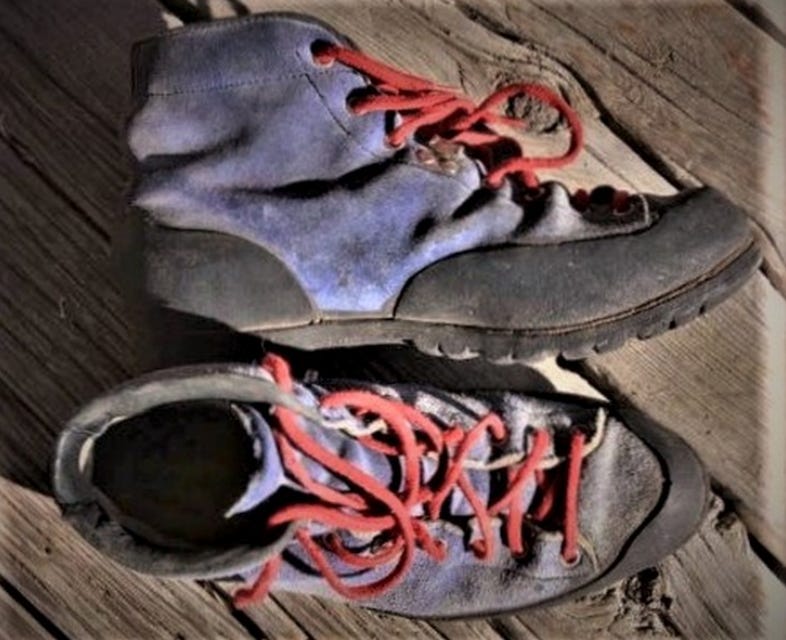
So I was wearing blue suede shoes the morning we danced across the glaciers on our blind date — lonely strangers who had answered a Hard Man Seeks Partner ad. We passed all the towers I had already climbed: Bugaboo (twice), Snowpatch (four times), Pigeon (three times), and finally the South Howser where Wayne and I put up Lost in the Towers a year earlier. And then, we rappelled down. The summit of The North Howser is not much higher than the South one, but base of the West Face is 1000 feet lower — hence, big wall. It seems like we bivouacked near some rusty tin cans, probably Fred Beckey’s.
In the morning we climbed long cracks lined with moss and at times running with water. Perfect for my skill set, and I must say, for the Robbins boots — good call, Ward. Eventually we angled over to a good ledge and spent a comfortable night. In the morning I led a hard tricky pitch (turns out I could climb 5.10 in those boots) to reach the start of the defining feature of the climb: a huge left-facing corner 160 meters long. The crack was consistently finger-width, and I soon realized we only had a few pieces of protection that size; the crack could be free-climbed1 but it would require bold run outs. So I switched to aid climbing — “leap frogging” the pieces that fit, leaving little to protect me if a placement failed.
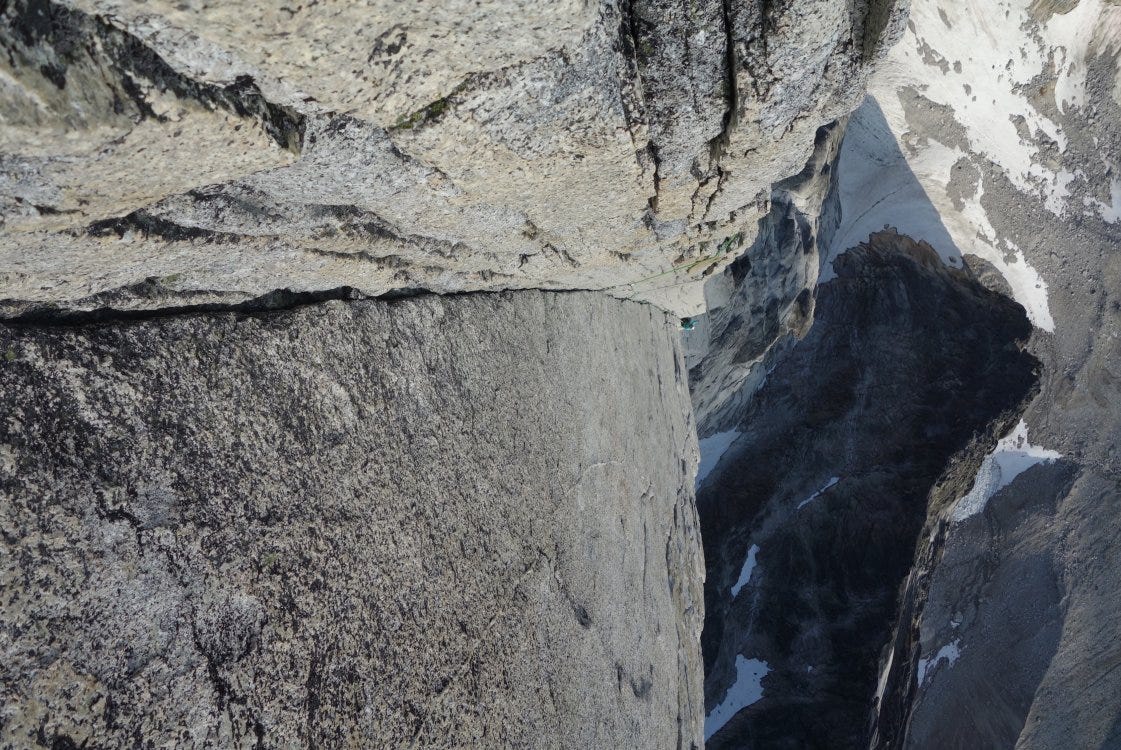
At the top the top of this amazing feature, 2000 feet off the ground, we had our first “getting to know you” conversation. Apropos to the blind date theme, Ward pulled out his pack of cigarettes and lit up (must have been a filterless Camel).
Ward: (after inhale, exhale) “The only way I’m going back down is if we drop my cigarettes, eh?”
Jim: (enjoying the second hand smoke) “Heh, ok.” Very funny. No fucking way we’re going down from here. Also, nearly impossible with amount of gear we have.
Ward: “Yah, well, I was here last year with fucking so-and-so2, and this is where he dropped the pack3. A climber like that doesn’t drop a pack by accident, aye, he didn’t want to do the climb with me.”
Jim: “oh damn, really?” Oh great, Ward’s partner last year fucked up, so now we have enough gear to go up but not enough to go down, not from this height. It’s a do-or-die rack.
Ward: (inhale, letting it all out now, exhale) “Yeah, and then I was on Pacific Ocean Wall4 last month, most of the way up. I sprained my ankle and it started raining so we stopped for a few days, but we were going to top out eventually. We were fucking fine! But the rescue team came down anyway, and pulled us off.”
Jim: “Well that’s one thing you don’t have to worry about. Nobody’s going to rescue us out here.” Not sure I actually said that.
Ward: (inhale, exhale, that was all a bit heavy, time for some small talk) “So, what other Grade VI’s have you done?”
Jim: “None. This is my first.” My turn to confess things. Grade VI virgin.
Ward: (pauses, not sure how to say it) “Maybe not the best place to start.”
Ward was more cheerful after that. There would be no going back and no being rescued; he could be redeemed. Ward was an aid climbing specialist and after removing one of the two friends I was using for the belay anchor (!yikes!) easily nailed his way across a short ‘blank’ section with a few knife blades. We continued on steep rock to a 6 inch wide ledge, where we hung in our harnesses and watched the sun set. We had of course a completely unobstructed view to the west, where magnificent thunderstorms soon formed and began moving toward us. The lightning was particularly fascinating to watch. More and more stars slipped behind the dark masses, but I felt no urgency. Because there was absolutely nothing to do but watch.
In the end there was no rainfall, and in the morning we continued. There were quite a few more pitches (big wall, eh?) but they got progressively easier until we were rambling across the summit ridge. We had neither food nor water, only coffee and cigarettes. At the belays we would brew up — make coffee by melting snow — but I still fell asleep while belaying. This would have been a good time to start smoking. Because, you know, we had fucking done it, celebration was in order. But first, prerogative of the first ascentionists, what was the route to be named? We agreed, referring to the feature that forms the giant dihedral, and as a nod to hard men everywhere, All Along the Watchtower. (The Jimi Hendrix version.)
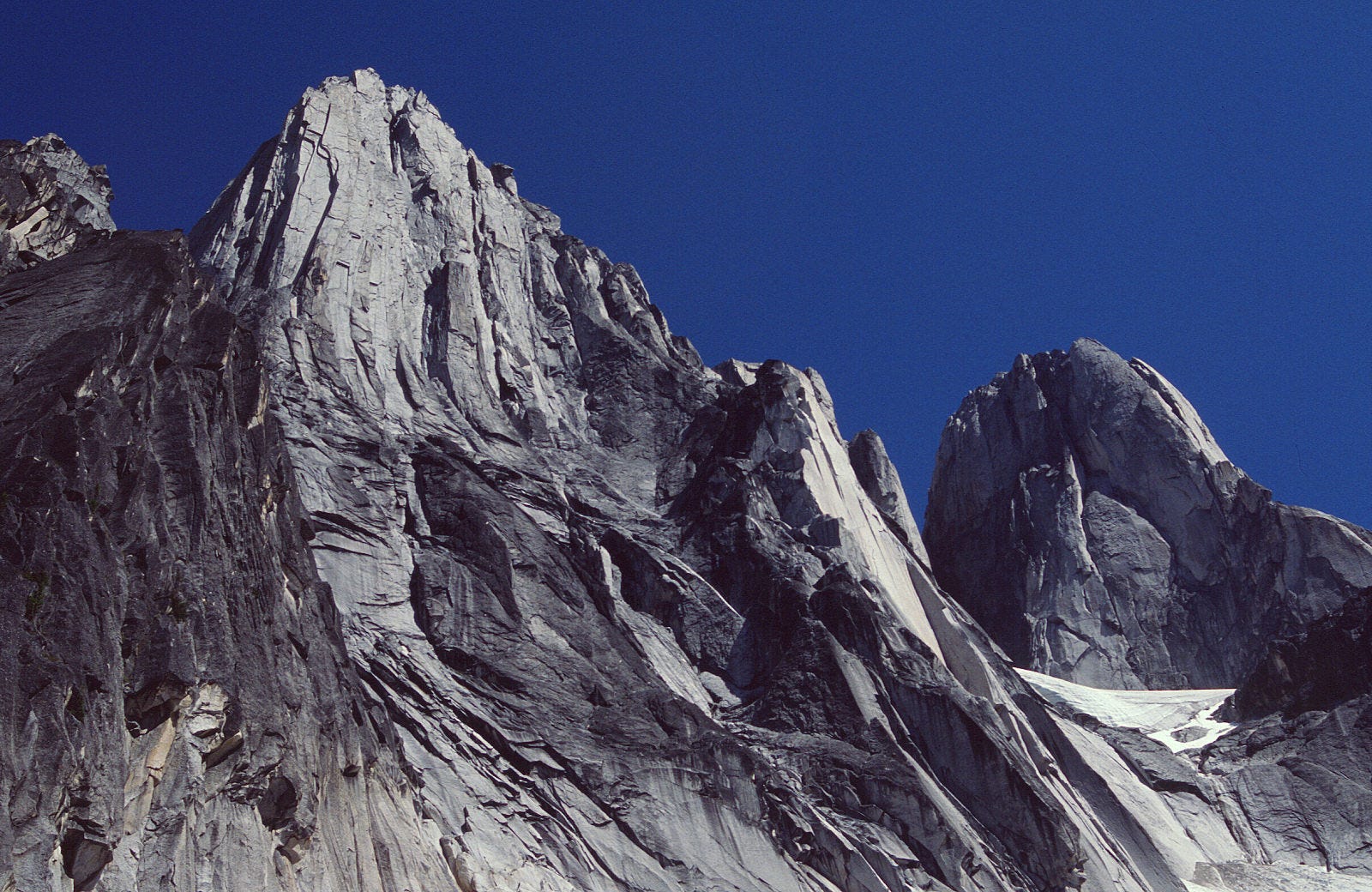
Ed’s note: Ward’s parting words back at the hut were, “We should climb together again some time, so we can learn to appreciate each other.” And we did. I ran into him in Yosemite the next spring and we climbed Central Pillar of Frenzy on Middle Cathedral. A pleasant jaunt it was, no brooding by either of us. Ward survived a famous epic on Nanga Parbat in 1989, but I can’t figure out where he is now. His daughter is a climber and artist in BC.
Four 5.11 pitches in the dihedral, according to next gen climbers who freed it. About gear, they call for “Double Rack to #3. Single #4. Triples in finger sizes for dihedral. Offset nuts, brassies.” That would have been nice.
some reputable Yosemite climber
Reading an online comment from Ward’s partner, Ken Trout, he dropped the bag on pitch 6, so Ward and I were the first ones up the corner.
or some serious climb like that on El Capitan
Thanks, Jim. Great scary story! David